Bike accidents can happen in a lot of different ways.
Sometimes you hit a patch of gravel, lose your balance, or take a corner a little too fast. Maybe your pedal catches something you didn’t see, your bike has a mechanical problem, or you simply make a mistake. Here in Southern Utah, where biking is part of everyday life for a lot of people, those accidents can happen on neighborhood streets, busy intersections, bike paths, and roads throughout St. George and the surrounding communities.
Bikes don’t offer much protection, so even an accident that doesn’t involve another person can leave you seriously injured.
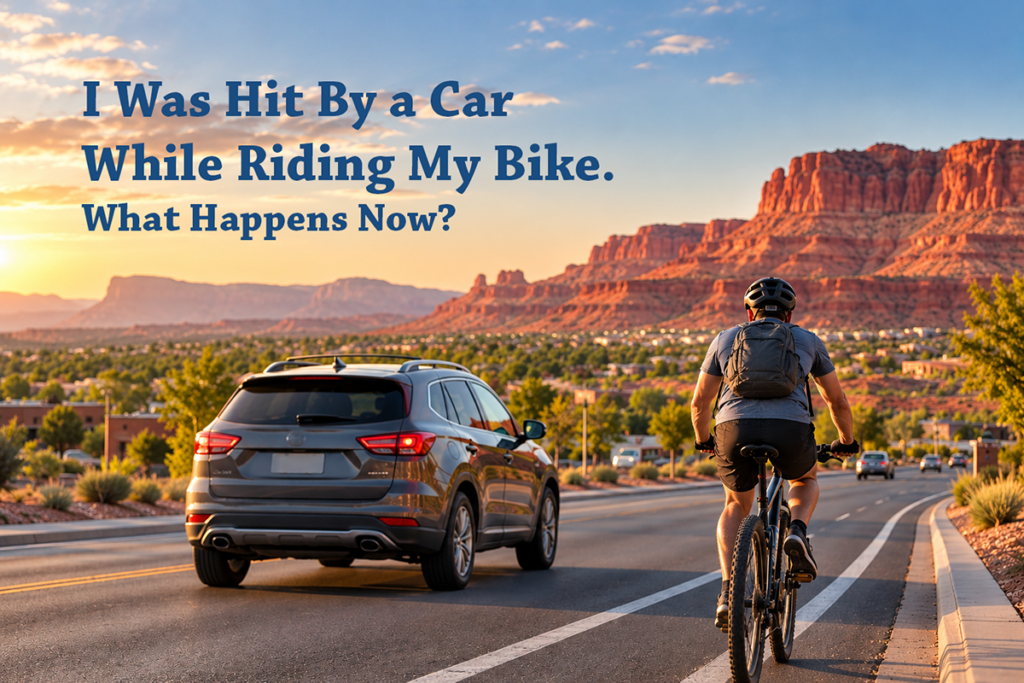
But this article is about a different kind of bike accident: you were hit by a car while riding your bike.
Maybe you were riding through an intersection when a car turned in front of you. Maybe a driver pulled out of a driveway or parking lot and didn’t see you. Maybe a vehicle came up behind you and the two of you collided. Sometimes there can even be more than one vehicle involved, or a cyclist can be pushed into another car or object during the crash.
Whatever happened, the immediate crisis is over. You’ve been checked out, you’ve talked to the police, and you’ve finally had a chance to get home and breathe.
Now the questions start.
What happens with your injuries? What about your bike? Is the driver’s insurance going to call? What if you’re still missing work? And what happens if the driver says the accident wasn’t their fault?
If you’ve been hit by a car while riding your bike, there can be a lot to sort through after the accident. Your injuries, your bike, the insurance claim, medical bills, missed work, and what actually happened all become part of the picture. Let’s talk through what comes next and what you should know as you start dealing with the aftermath.
First, Let’s Talk About Your Injuries
One of the first things we’d want to know is how you’re doing.
When a car is involved in a bike accident, the injuries can be significant. A bicycle offers very little protection when you’re suddenly thrown into the road or another vehicle, and the full extent of an injury isn’t always obvious right away.
A bike accident can leave you dealing with much more than the initial pain from the crash. You may be facing surgery, physical therapy, follow-up appointments, medication, or a long period of recovery. Depending on the injuries, you may also be dealing with limitations on what you can do at work or at home.
That’s why your medical treatment becomes an important part of what happens after the accident. Keep following up with your doctors and other healthcare providers, and keep track of the care you’re receiving. Your medical records help document the injuries you suffered and the treatment you’ve needed since the crash.
Your doctors are focused on helping you recover. When we’re looking at the bigger picture of the accident, we also want to understand what that recovery has looked like for you and how the injuries have affected your everyday life.
Then There’s the Bike
Once you’re dealing with the medical side of things, there’s usually another question sitting in the back of your mind: what happens to your bike?
You know what you paid for it. You know how long you’ve had it, how well you’ve taken care of it, and what you’ve added to it over the years. Maybe you’ve spent years riding it and have upgraded parts along the way. Maybe it’s a high-end bike that was a significant investment.
Then the insurance company looks at it and comes up with a number that doesn’t feel anything like what you think it’s worth.
That can be frustrating, especially when you’re already dealing with injuries and everything else that came with the accident.
The question isn’t simply whether the bike was damaged. It’s what the damage means. Can it be safely repaired? Is it actually worth repairing? What would it cost to replace the bike with something comparable? What about the equipment that was damaged along with it?
Those questions are part of the property-damage side of the claim. And while the bike matters, it’s still only one piece of what you’re dealing with after a serious accident.
Then the Insurance Questions Start
This is often where the aftermath starts to feel less straightforward.
The other driver’s insurance company may call you. When they do, you may be surprised by how many questions they have.
What happened? Where were you riding? What were you doing immediately before the crash? What injuries did you have? Have you seen a doctor? Are you still treating? Have you missed work? What happened to your bike?
It can feel like a lot, especially when you’re still trying to recover and some of those questions don’t have simple answers.
But there’s a reason they’re asking. The insurance company is trying to put together the story of the accident and understand the losses you’re claiming. That means they’re looking at more than just the damage to the bike or the first medical bill. They’re trying to understand what happened, what injuries resulted, what treatment you’ve needed, and what the accident has cost you.
That’s also why you may hear some of the same questions more than once. The adjuster may be working through different parts of the claim—liability, medical treatment, lost income, property damage, or other losses—and each piece needs to be documented.
For example, saying “my back hurts” tells the adjuster that you’re experiencing pain. Your medical records can provide much more information about the diagnosis, treatment, and how the injury has progressed. Similarly, saying “my bike is ruined” is different from having information about the bike’s condition, the damage, the cost of repairs, or what it would take to replace it.
The more complicated the accident, the more pieces there may be to put together. If there were multiple vehicles involved, witnesses who saw different parts of the crash, or questions about how the collision happened, the insurance investigation may involve looking at all of those pieces before the claim can be evaluated.
For claims being handled in Utah, there are also rules governing how insurers investigate and handle property and casualty claims, including standards for investigating claims and communicating with claimants.
That doesn’t mean every conversation with an adjuster is a problem or that you should assume the insurance company is acting unfairly. It simply helps to understand what is happening on the other side of the conversation: the adjuster is trying to determine what happened and what the insurance company believes it owes.
And sometimes, that’s where the questions get harder. The insurance company’s understanding of what happened—or what the claim is worth—may not match yours.
What If the Insurance Company’s Version Doesn’t Match Yours?
This is where things can get frustrating.
You remember the accident one way. The other driver may remember it differently. The insurance company may come to a conclusion that doesn’t line up with what you remember happening.
Maybe you remember having the right of way, but the driver says you moved into their path. Maybe the driver says they never saw you, while you remember making eye contact with them before they turned. Or maybe there were multiple vehicles involved, and each person has a different version of how the crash unfolded.
When that happens, the question isn’t simply whose story sounds more convincing. It’s whether the available information supports one version of what happened over another.
That’s where the details of the accident can become important. A police report, a witness statement, video footage, or the damage to the bicycle and vehicles may provide information that isn’t obvious from either person’s memory of the crash.
Sometimes those pieces fit together neatly. Other times, they raise more questions.
If the insurance company has reached a conclusion that doesn’t make sense to you, it can be worth understanding how they reached it and what information they relied on. Sometimes the disagreement isn’t about whether an accident happened at all. It’s about how everyone involved understands what happened.
That can be especially important when an accident happens at a busy intersection or along one of the roads commonly used by cyclists around St. George, Washington, Santa Clara, or Hurricane. Understanding the layout of the road, the direction everyone was traveling, and what each person could see can sometimes help explain how the collision happened.
What About the Bills?
Once the accident starts affecting your everyday life, the questions become a lot more practical.
You may have medical bills coming in. You may have missed work because of your injuries or because you’re going to appointments. Maybe you need additional treatment that you weren’t expecting. If your bike was your transportation, you may even be trying to figure out how you’re getting around while it’s being repaired or replaced.
Those things can add up quickly.
One thing that can be confusing is that the bills don’t necessarily wait for the insurance claim to be resolved. Your doctor’s office still sends the bill. Your health insurance may process the treatment. Your employer may expect you back at work even though you’re not ready.
So you can find yourself dealing with the financial consequences of the accident while the insurance side of things is still being worked out.
Part of our job is helping with that side of the process. While you’re focused on getting treatment and recovering, we’re working to understand the financial impact of the accident and make sure those losses are part of the bigger picture we’re putting together.
When Does It Make Sense to Get Help?
Not every bike accident requires an attorney. Some claims are fairly straightforward, and you may feel comfortable handling the insurance process yourself.
But if you’re dealing with serious injuries, ongoing treatment, significant time away from work, or questions about what happened, it may be helpful to have someone else take over the legal and financial side of the claim.
That’s part of what we do. We can look at what happened, help you understand how the different pieces of the claim fit together, and handle the insurance process while you focus on recovering.
You Were Hit by a Car. What Happens Next?
A bike accident can change a lot in a matter of seconds. What started as a bike ride can turn into medical appointments, a damaged bike, insurance calls, missed work, and questions about what happens next.
The aftermath can take time to sort through, especially when you’re dealing with serious injuries. If you’ve been hit by a car while riding your bike in St. George, Cedar City, Mesquite, or elsewhere in Southern Utah, we’re happy to talk through what happened with you and help you understand what may apply to your situation.