
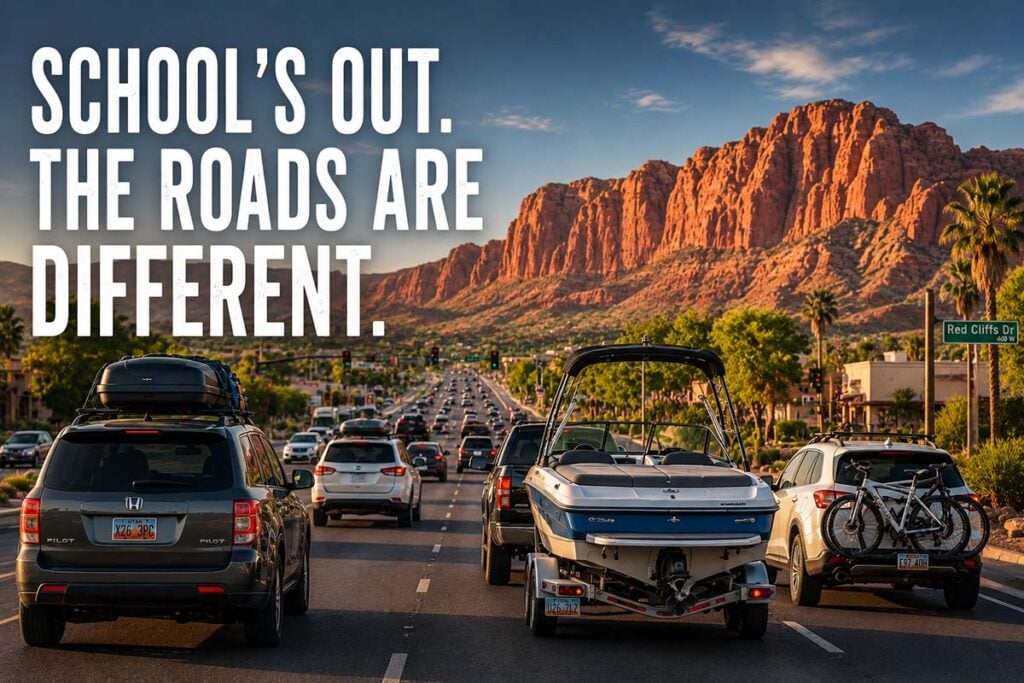
Last Friday, the final school bell rang across much of Southern Utah.
For students, it marked the beginning of summer. For parents, it meant camps, vacations, sports schedules, and a sudden shift in routine. By Monday morning, life already looked a little different than it had the week before.
The roads did too.
Not dramatically. There wasn’t a sudden surge of traffic or a noticeable change overnight. Instead, the signs appeared in small ways.
A truck pulling a boat through town on a weekday morning.
A family vehicle packed for a road trip.
Teenagers with freshly earned summer freedom.
Visitors following GPS directions through unfamiliar intersections.
None of it seems unusual because, in Southern Utah, it isn’t.
In fact, that’s exactly the point.
Summer arrives not with one major change, but with thousands of small ones.
The Real Meaning Behind the “100 Deadliest Days”
Most people have heard the phrase “100 Deadliest Days of Summer.” Safety organizations use it to describe the period between Memorial Day and Labor Day, when traffic accidents involving young drivers tend to increase.
The phrase gets attention because it sounds dramatic.
But focusing on the name alone can miss the more important lesson.
Summer doesn’t suddenly create dangerous drivers.
It changes the way people live.
For most of the year, life follows a predictable rhythm. School starts at the same time each morning. Parents commute familiar routes. Teenagers drive to the same places. Families settle into routines that repeat week after week.
Then summer arrives and that rhythm disappears.
The teenager who drove only to school and back is now driving to work, activities, friends’ houses, and late-night events. Parents spend more time coordinating camps, tournaments, and vacations. Families head out on road trips. Visitors pour into Southern Utah to experience Zion, Bryce Canyon, Snow Canyon, and the many outdoor opportunities that make this area unique.
The roads themselves remain the same.
The people using them are suddenly doing very different things.
Most Accidents Start With Ordinary Decisions
That matters because most accidents do not begin with reckless decisions.
They begin with ordinary ones.
A driver glances down at directions while looking for an unfamiliar address. A family trying to make good time on a road trip pushes a little farther before stopping for a break. Someone towing a trailer navigates heavier traffic than expected. A teenager drives with a car full of friends for the first time.
None of those situations are inherently dangerous.
Most happen every day without incident.
But when more people find themselves in unfamiliar situations, making decisions they do not normally make, the opportunities for mistakes naturally increase.
Southern Utah Has Its Own Summer Traffic Story
Southern Utah experiences this transition in a unique way.
Unlike many communities, summer doesn’t simply mean local residents are driving more. It also means sharing the road with visitors from all over the country. Some drivers know every turn and intersection by memory. Others are seeing the area for the first time.
One vehicle may be heading home from work.
Another may be eight hours into a family vacation.
One driver knows exactly where they’re going.
Another is relying entirely on GPS.
Each driver brings different expectations, different experiences, and different levels of familiarity to the same roads.
Most of the time, everyone gets where they need to go safely.
But summer has a way of creating more variables than the rest of the year.
A Better Way to Think About Summer Driving Safety
That is why summer driving safety matters.
Not because the season itself is dangerous.
Not because every teenager is reckless.
Not because every tourist is distracted.
Summer driving safety matters because routines matter. And when routines change, people have to become more intentional about the choices they make behind the wheel.
A little more patience at an intersection.
A little more distance between vehicles.
A little more attention to the road ahead.
A little more willingness to stop and rest before continuing a long drive.
Those small choices rarely make headlines.
But they are often the difference between arriving safely and becoming part of a statistic.
Summer is one of the best times of year in Southern Utah. Families gather. Kids experience more freedom. Vacations begin. Memories are made.
The goal isn’t to be afraid of summer.
It’s simply to recognize that when school gets out, the roads really are different.
Not because summer changes the roads.
Because summer changes us.
And if an accident does happen somewhere along the way, understanding your options early and knowing how the insurance process works can make a difficult situation much easier to navigate. Even straightforward crashes often become more complicated than people expect once injuries, medical treatment, and insurance questions enter the picture. Give us a call, and we can help.