Over the past few years, e-bikes have become a much more common sight around Southern Utah. You see them in neighborhoods, on trails, and even along some of the busier roads.
For a lot of families, they’ve been a convenient way to get around. For others, they’ve raised some real questions about safety – especially when younger riders are involved.
That’s part of why the updated Utah e-bike law is getting attention right now.
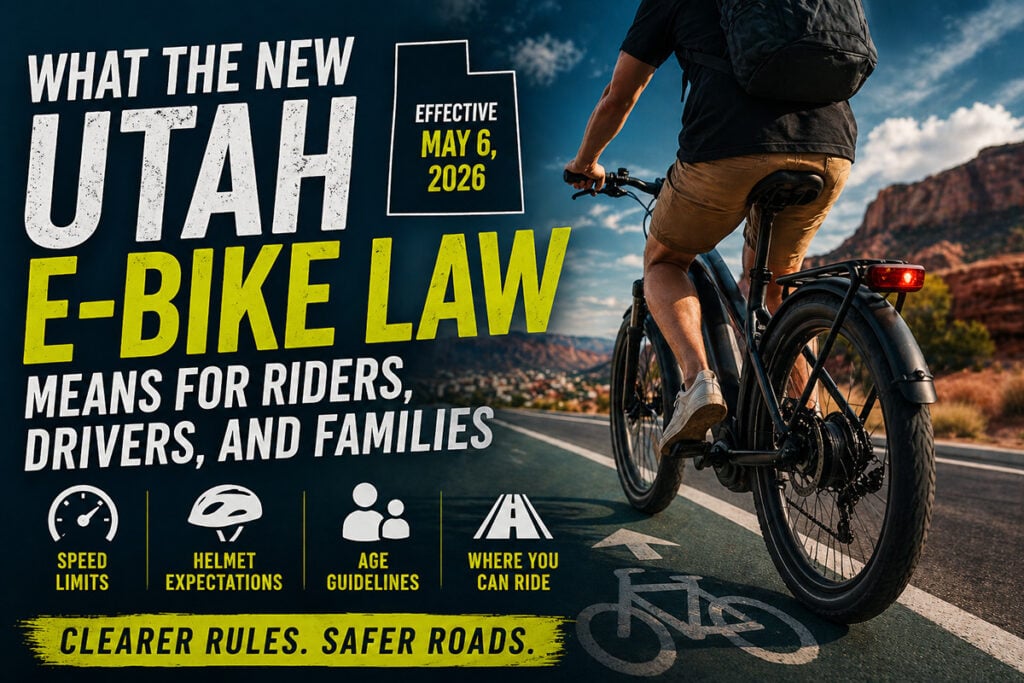
Starting May 6, 2026, new rules will shape how e-bikes are used across the state. And while the changes aren’t overly complicated, they do matter – both for the people riding and the people sharing the road with them.
Why the Law Is Changing
E-bikes have grown faster than most people expected. What used to feel like a niche option is now something you see every day, especially in places like St. George and surrounding communities.
With that growth has come a mix of situations: kids riding at higher speeds, riders moving between sidewalks and roads, and drivers not always sure what to expect.
The updated law is an attempt to bring a little more clarity to all of that. Not to restrict e-bikes entirely, but to set more consistent expectations for how and where they’re used.
What the New Utah E-Bike Law Actually Says
Starting May 6, 2026, Utah’s updated e-bike law focuses on a few key areas: how e-bikes are classified, where they can be ridden, and how those rules apply in everyday situations.
E-bikes are still divided into three classes:
- Class 1: Pedal-assist only, up to 20 mph
- Class 2: Throttle-assisted, up to 20 mph
- Class 3: Pedal-assist, up to 28 mph
That part isn’t entirely new, but the law puts more real-world weight behind those distinctions.
One of the biggest practical changes is where certain e-bikes can be used. Higher-speed bikes, especially Class 3, are more restricted in pedestrian-heavy areas like sidewalks and some shared-use paths. In many cases, they’re expected to be used on roads or in bike lanes instead.
The law also gives more structure to how local cities can regulate e-bike use, which should reduce some of the confusion that’s come from different rules in different areas.
If you’ve been trying to make sense of the e-bike rules in Utah, that’s really the goal here: fewer gray areas, and fewer situations where people are guessing what’s allowed.
Helmet Expectations and Age Guidelines
One area the updated law is trying to make clearer is how higher-speed e-bikes, especially Class 3, should be treated when it comes to safety.
For Class 3 e-bikes, helmet use is generally expected, particularly for younger riders. At speeds up to 28 mph, the risk starts to look a lot different than a traditional bike, especially when riding near traffic.
For Class 1 and Class 2 e-bikes, helmet use is still strongly encouraged, especially for kids, but the expectations are less strict compared to Class 3.
There are also age-related guidelines to be aware of. In most cases, Class 3 e-bikes are intended for riders who are at least 16 years old, especially when they’re being used on roadways.
If you’re not sure what class your e-bike falls into, it’s worth checking, because the rules can change depending on that.
Do Kids Need a License to Ride an E-Bike?
This is one of the most common questions people have.
The short answer is: no, e-bikes do not require a driver’s license in Utah, even for younger riders.
They’re still treated as bicycles under the law, which means you don’t have registration, insurance, or licensing requirements like you would with a car.
That said, the type of e-bike and the rider’s age can still affect where and how it’s supposed to be used.
What This Means for Families
For many families, the biggest concern isn’t the law itself – it’s how it applies to their kids.
E-bikes can move faster than they look like they should, and that can create situations where younger riders are mixing with traffic in ways that weren’t as common a few years ago.
The updated law gives parents a clearer framework for what’s appropriate, especially when it comes to speed, location, and supervision.
It’s not about taking something away – it’s about making sure expectations are clear before something goes wrong.
What Drivers Should Be Aware Of
From a driver’s perspective, e-bikes can be unpredictable if you’re not used to them.
Some riders may now be more consistently in the roadway, especially those on higher-speed bikes, rather than on sidewalks or paths. That shift can take some getting used to.
As the Utah e-bike law 2026 changes take effect, there will likely be an adjustment period. Not everyone will be fully aware of the new rules right away, and that’s often where risk shows up.
A little extra awareness – especially in areas where e-bike use is common – can go a long way.
Where Liability Can Get Complicated
One of the quieter impacts of these changes is how they can affect fault if something does go wrong.
If an accident involves an e-bike, questions may come up about:
- where the rider was allowed to be
- whether the bike fit its proper classification
- how both the rider and driver were behaving
These situations aren’t always straightforward, and small details can matter more than people expect.
That doesn’t mean every incident turns into a major legal issue. But it does mean the rules themselves can play a role in how responsibility is evaluated.
A Shift Toward Clarity
At the end of the day, the updated law isn’t about making things complicated. It’s about making them clearer.
E-bikes aren’t going anywhere. If anything, they’ll continue to become a bigger part of how people get around in places like Cedar City and Mesquite.
Having clearer expectations – both for riders and drivers – helps reduce confusion and, ideally, prevent situations that lead to injuries in the first place.
If you’re using an e-bike, or sharing the road with someone who is, it’s worth taking a few minutes to understand what’s changing and how it applies to you. If you have questions, give us a call. We’d love to talk with you!